Knowing
How we distinguish what is supported, inferred, provisional, mistaken, or unknown—and what new evidence obligates us to reconsider.
02 · Human / artifact story
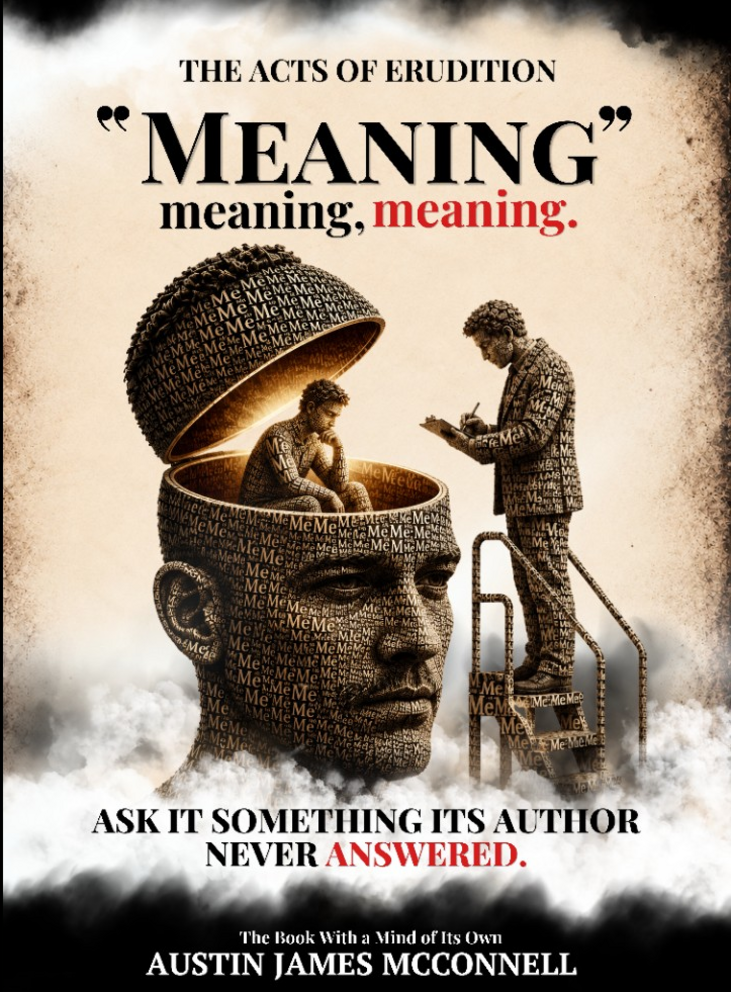
The Acts of Erudition began as my attempt to make sense of the tensions in my own life and thinking.
I didn't set out to build an AI experiment, formalize a reasoning architecture, or preserve some model of myself. I was trying to understand what I believed, why I believed it, and what should happen when experience gave me a reason to change my mind.
Over roughly a decade, that private process became a book.
Only after the book existed did another possibility become visible: perhaps I had written down enough of the structure behind my reasoning for something other than me to use it.
The question
“How do you build a coherent way of understanding the world when the things you believe, value, experience, and learn do not always agree with one another?”
I kept returning to that problem because resolving one contradiction rarely ended the larger problem.
What counts as knowledge? What happens when certainty ends? What do I owe the people around me? Which responsibilities survive inconvenience? When should a belief be defended, and when does defending it become refusal to acknowledge evidence? If something I believe depends on something that turns out to be false, what else has to change with it?
Those questions reached into faith, evidence, identity, relationships, community, responsibility, and ordinary life.
Eventually I realized that I wasn't only trying to decide what I thought.
I was trying to understand how I decided what deserved to become part of what I thought at all.
Approximately a decade of development
I didn't begin with a formal system and try to fit myself into it. The framework emerged in the opposite direction. I wrote distinctions down, lived with them, encountered situations that challenged them, and revised or abandoned what could no longer survive the confrontation. The architecture came later.
Belief, evidence, faith, responsibility, identity, community, and ordinary life did not always point in the same direction. I stopped treating that tension as something that had to be hidden.
Writing gave me somewhere to preserve questions and working distinctions that private reflection could otherwise distort or forget. A conclusion mattered less if I couldn't recover how I had reached it.
Ideas repeatedly encountered experience, contradiction, new information, and changing understanding. Something I had written was allowed to become wrong.
Structures that continued to explain my reasoning survived. Others changed. Some were discarded entirely. Revision wasn't an exception to the framework. It became part of how the framework worked.
Eventually, recurring structures became difficult to ignore. The Four Pillars emerged. ESPS followed. Only then did it become possible to ask whether that architecture could be bounded and tested.
The Four Pillars
The Four Pillars are not four answers. They are recurring domains through which questions in the book are organized and brought into relationship with one another.
How we distinguish what is supported, inferred, provisional, mistaken, or unknown—and what new evidence obligates us to reconsider.
What we carry forward when knowledge ends: the commitments, assumptions, and provisional positions required to act despite uncertainty while remaining capable of revision.
The relationships, loyalties, responsibilities, environments, and material conditions through which a life becomes inhabitable and personally situated.
How an individual life reaches beyond itself through work, care, creation, responsibility, and participation in something shared.
These descriptions orient the visitor. The book and frozen ESPS archive govern the definitions used in formal testing.
Eso-Syncretic Psycho-Symmetry
ESPS attempts to describe something more dynamic than a person's current worldview. It asks what happens between information and conclusion.
How is new information interpreted? What receives greater weight? Which existing commitments constrain the answer? What happens when structures conflict? What changes when a premise fails? Which conclusions depend upon it? Where does knowledge end and uncertainty begin?
ESPS is my attempt to make those relationships explicit enough to inspect.
Within the experiment, ESPS has another function. It provides a formal architectural record against which the author's reasoning can be described, challenged, reconciled, and eventually revised across bounded versions.
ESPS v1.0 is not presented as a universal theory of human cognition or as a finished description of me. It is the first formally bounded specification produced by this process.
Its value here depends less on whether every part proves correct than on whether it makes enough of the architecture visible to be tested, contradicted, reconciled, and improved without rewriting the history of what came before.
The Acts of Erudition
The Acts of Erudition was written to stand on its own as a philosophical and deliberative work. It was not originally written as an AI dataset, persona specification, digital twin, or technical product.
The book preserves conclusions, but it also preserves the structures surrounding them: distinctions, priorities, conceptual relationships, unresolved tensions, competing constraints, uncertainties, and repeated acts of revision.
A collection of conclusions can tell you what someone thought. A sufficiently rich record of the relationships that produced and changed those conclusions might reveal something about how that person thought.
The book does not contain a complete mind, nor does this project claim that it does. It contains a bounded artifact produced through approximately a decade of one person's attempt to make his reasoning increasingly explicit.
That made a different kind of experiment possible.
From book to deliberative artifact
The technological question came after the book. Once the manuscript contained enough of the distinctions, priorities, tensions, constraints, and revision mechanisms through which I actually reasoned, I began wondering whether a language model could do something more interesting than retrieve or summarize what I had already written.
Could it use those structures to reconstruct how I would approach something I had never written about?
The question was no longer only whether a book could preserve what its author had thought. It became whether a sufficiently explicit deliberative artifact could preserve enough of the architecture behind those thoughts for that architecture to be reconstructed forward into novelty.
Development had been recursive: reasoning produced writing, writing produced reflection, reflection altered reasoning, and the artifact changed with it.
Experimentation required the opposite. A version had to stop changing.
So the artifact was bounded and versioned, and the author was removed from the reconstruction process. Now the artifact has to answer for itself.
Could I make the structure behind my own thinking explicit enough to examine, reconcile, and revise it?
What happens if that structure becomes explicit enough for something else to use it on a genuinely new problem?
Why the author is tested first
The author is tested first for a practical reason: this artifact developed from his reasoning, and he remains available as the human reference against which its reconstructions can presently be compared.
The artifact can be given a genuinely novel problem without access to the author's answer. The author can independently confront the same problem. The resulting reasoning can then be compared—not merely for matching conclusions, but for continuity in distinctions, constraints, weighting, reframing, revision, and the movement from premise to conclusion.
The experiment does not assume that the author's reasoning is uniquely correct. It does not assume that an AI using the artifact becomes the author. And agreement alone does not establish reconstruction.
The author is therefore the first reference subject, not the intended endpoint. If the method eventually means anything beyond this particular case, it must become possible to determine whether another person's intellectual architecture can be externalized, bounded, tested, reconciled, and reconstructed through the same general process.
Follow the experimentThe larger question
Modern AI can already imitate many observable characteristics of individual people with substantial fidelity. Biography, remembered information, linguistic style, conversational mannerisms, voice, appearance, and other recognizable features can increasingly be reproduced.
That is not the problem I'm trying to solve. I'm interested in what sits underneath the imitation:
Can enough of a person's intellectual architecture be externalized that, after the person is gone, it can continue encountering new information and producing new reasoning that remains structurally continuous with the intellect that produced it?
Not the person. Not consciousness. Not a claim that a reconstruction somehow is the human being from whom it originated.
The question is whether something of that person's intellectual process can remain operational: capable not only of reproducing old answers, but of confronting a world its source never lived to see.
That requires more than remembering what someone believed. It requires preserving enough of the mechanisms by which beliefs changed.
A reconstruction that can sound like someone is an imitation. A reconstruction that can answer like them is more interesting. But the harder question is whether it can encounter something they never knew, discover that an old conclusion can no longer stand, and change in a way that remains structurally continuous with how that intellect changed while its source was alive.
That is the frontier this experiment is approaching.
The physical artifact
The physical form matters because the experiment needs an identifiable source. A bounded edition gives readers the same object and gives testing a source condition that cannot quietly change after an unsuccessful result.
Development is recursive. Testing is frozen. Once a version enters a planned testing period, that version remains fixed. Results accumulate against the artifact that actually produced them. Reconciliation and revision come afterward. If the architecture changes as a result, that change belongs to a subsequent version—not a rewritten past.
Ownership / access
The owner experience connects the physical edition to the AI-ready / LLM edition, four complete Ask the Book prompt modes, ESPS archive, protocols, controls, scoring and investigator materials, data instruments, and version manifests. These materials do not replace the book. They make the same bounded artifact usable across reading, questioning, reconstruction, and formal testing while preserving identifiable source and version conditions.
Book availability
Public purchasing is not yet open. When distribution is finalized, purchase options will be linked here. Ownership of the physical edition will provide access to the corresponding owner materials through the site's verification gateway. No release date is being promised until those distribution arrangements are complete.
Another door
Follow the transition from a bounded book to a falsifiable question about whether reasoning architecture can be reconstructed forward into genuinely novel problems.
04 · ApplicationSee what the architecture can doExplore practical use, knowledge modes, attribution boundaries, and the difference between useful reasoning and experimental evidence.